

In this talk, Dr. Thomas M. Fehlmann, a software quality management expert, presents autonomous real-time testing for cyber-physical products as a parallel activity to DevOps that builds confidence in such products. He covers model-based functional testing, user needs testing, and digital twins with Kubernetes.
- Why cyber-physical systems need a new testing principle
- Model-based functional testing
- User needs testing: privacy, security, emotional and business needs
- Digital twins and Kubernetes
- Compliance and testing as part of development, delivery and deployment
International software quality management expert Dr. Thomas Fellmann talks about software testing as an autonomous, parallel to DevOps activity, necessary for building confidence in cyber products.
Autonomous real-time testing is suitable for those ready to combine disciplines that are actually not so easy to combine.
Autonomous Testing
Testing cyber-physical systems is different from testing third-generation microprocessors. The reason is completely new work principles. For example, an autonomous car. Such a vehicle is updated every 10 days, connected to a smartphone and a cloud service, and learns new behavior. It is fundamentally different from old-fashioned software that works following the written code only.
ART lasts exactly as long as the cyber-physical system works. It can be launched anytime, anywhere, for a limited time, and individually.
Functional testing models
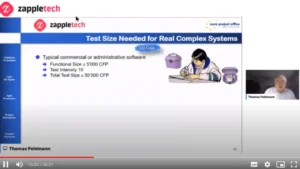
The relevance of automatic testing is explained by the number of necessary tests for systems of different generations. So, if third-generation software requires testing of 50,000 SPF, then for a complex system with intensive software, their number increases to 25 million. And such amount of tests cannot be written manually.
It’s the main reason why this type of testing is model-based. Dr. Fellmann is the author of a model for autonomous vehicle driving based on just 37 data movements. Thanks to this model, testing all the code is no longer necessary.
User Needs Testing
To perform this kind of testing, it is necessary to determine what your users want.
Target user values:
- privacy;
- security;
- emotional needs;
- business needs.
Knowing user preferences, you can consider them when creating your user stories, which must be covered by tests. It will help you test things critical for the clients.
Digital Twins and Kubernetes
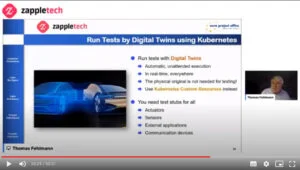
Digital twin testing involves:
- automatic execution;
- good performance anytime and anywhere;
- no need to test the physical original;
- using Kubernetes Custom Resource.
The idea is that you track motion sensors and cameras, monitor reactions of mechanisms, and create a unique story for each system by providing each component with a digital twin.
Conclusion
Software compliance is highly valued by users. It is essential in medicine, autonomous vehicles, artificial intelligence, the Internet of things, and other cyber-physical systems. Therefore, testing becomes an integral part of product development, delivery, and deployment.
 Mikhail Bodnarchuk ·
 Mykhailo Poliarush ·