

In this talk, Jenna Charlton, a tester with 10 years of experience, looks at how low-code and no-code tools can help teams move from manual testing to automation. She covers team challenges, three options and their trade-offs, the limits of AI, and why manual and automated testing should exist in parallel.
- Challenges for teams on the path to automation
- Three options: do nothing, start automation, or use low and no code
- Why low and no code deserves attention
- Limits of AI and the benefits of AI-assisted automation
- Manual and automated testing in parallel
Jenna Charlton, 10-year tester, tech blogger, trainer, product owner, and attendee at many IT conferences, talked about how using Low and No Code can help teams move beyond manual control to automation.
Challenges for Teams on the Path to Automation
There are some challenges for today’s development teams that are on the automation path:
- Time pressure — automated tests take time to create and maintain.
- High cost — even if you don’t have to pay for open source code, there will be costs to maintain and learn it.
- Lack of Skills — everyone has knowledge gaps, and no team is fully prepared to move to automated testing.
- Difficulties at decision making — there are hundreds of paid tools, dozens of open source tools, you can create your own framework. Such a huge number of options makes it difficult to choose.

Potential solutions:
- Doing nothing.
- Still starting an automation project. Moreover, it should be taken into account that this means not just starting to use specialized software, but starting the process of its development, implementation, training in its use, and only then directly using it for testing.
- Use the Low and No Code.
Pros of each option:
- Leaving things the way they are is the easiest and most convenient — changes always mean hardship.
- Starting the automation process is a long-term, scalable solution. It can improve the skills of the team because it requires training.
- The Low and No Code solution is also, in most cases, scalable and long-term and also requires certain knowledge and skills.
Disadvantages of each solution:
- Failure to automate will sooner or later lead to the complete collapse of the company.
- The automation process requires funds, time, skills, and support.
- The use of No Code and Low Code approaches is also quite expensive and may face a lack of technology.
Why is Low and No Code development worthy of attention?
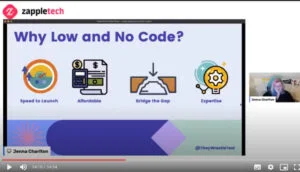
There are several reasons:
- Launch speed.
- Availability.
- Filling gaps in knowledge and skills.
- Gaining experience.
The future belongs to artificial intelligence – is it so?
Artificial intelligence cannot completely replace a real tester. It cannot think, feel, or rationalize experience. All he can do is help you with your analysis. But you still need a real user to test the software. Therefore, you can automate only those tests that do not have a significant impact.
Benefits of AI-assisted automation:
- Ability to compare — how it looked before the changes and how it looks now.
- Self-healing.
- Reducing the time required to maintain tests.
Conclusion
According to Jenna, manual and automated testing should exist in parallel. Automation is important, of course, but there are tasks that only people should do. These are relationships between stories, identifying testability issues, risk analysis, and traceability.

 Mikhail Bodnarchuk ·

 Mykhailo Poliarush ·